enablegrowth through strategic frameworking (#1 Pet Food industry)
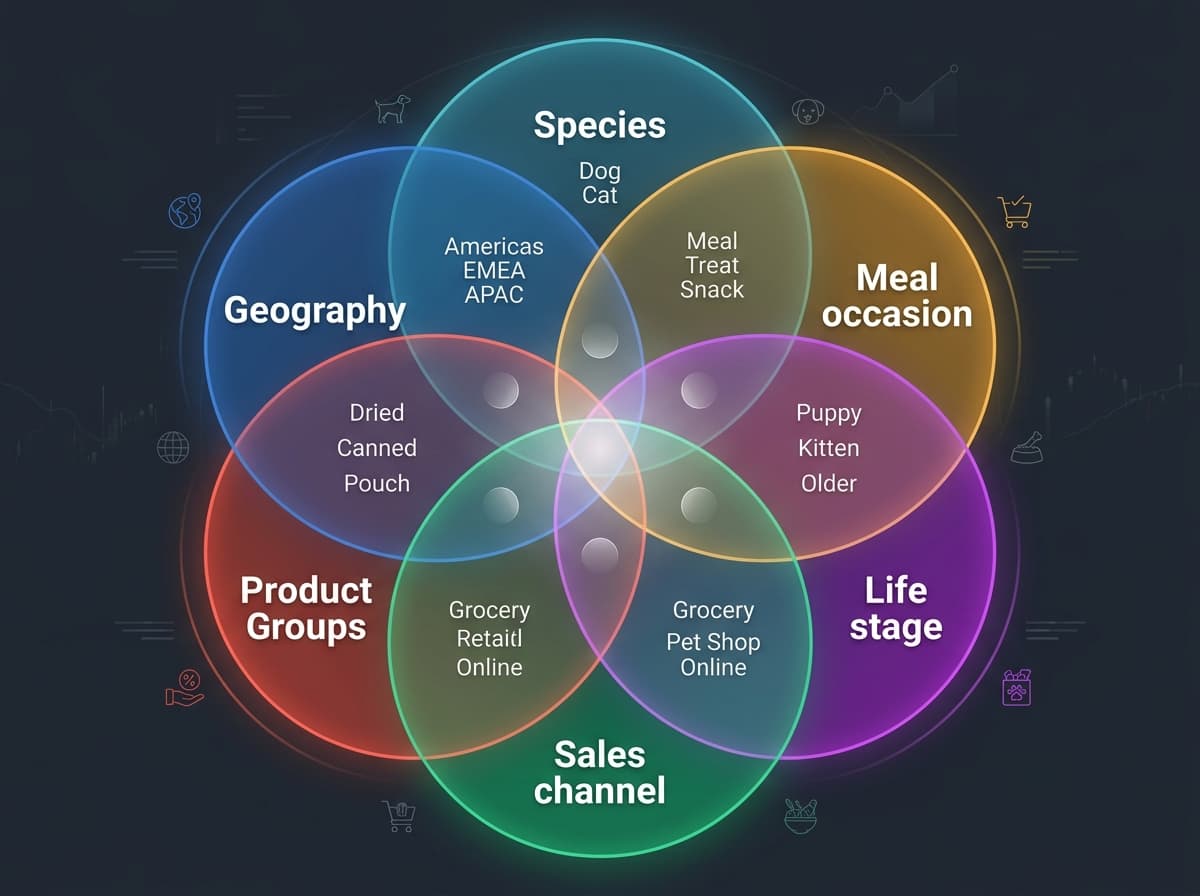

This article is the first in a series on industry-specific strategic frameworking applications. In pet food, the method is especially useful because growth is being reshaped by premiumization, private-label pressure, changing shopper behavior, and the rise of direct-to-consumer commerce. The companies that outperform are not those with the broadest vision statements; they are the ones that convert market complexity into clear strategic choices and operating roles.
What is strategic frameworking?
A strategic framework is the architecture that connects where a business wants to win with how it organizes decisions, people, and investments. In practice, it helps a company move from abstract ambition to a set of concrete choices about categories, channels, geographies, customer segments, and capabilities.
That matters because strategy is often undermined not by lack of intent, but by weak translation. HBR has long argued that a strategy only creates value when it becomes actionable through a coherent set of trade-offs, capabilities, and operating priorities; otherwise it remains a statement of aspiration rather than a guide to action. Harvard Business Review Strategic frameworking is designed to solve exactly that problem.
Why does it matter in pet food?
Pet food is no longer a simple volume game. NielsenIQ and other market trackers have documented the long-running shift toward premium, functional, and health-oriented products as pet owners increasingly treat pets like family members. That trend is reinforced by e-commerce, subscription models, and a willingness to pay more for ingredients, convenience, and trust.
At the same time, the category is fragmented by species, life stage, diet type, price tier, and channel. A premium wet cat food brand in the U.S. faces a different growth equation from an economy dog kibble line in the U.K. grocery channel. A framework that segments these choices explicitly is therefore not administrative overhead; it is the operating system for growth.
BCG has repeatedly shown that category leadership comes from focusing on the specific arenas where a company can win, not from trying to win everywhere at once. BCG In pet food, that means choosing the right combination of pet type, need state, channel, and price architecture rather than pursuing generic “growth.”
What is the purpose of the framework?
The purpose is to define how people, teams, and functions are connected around a shared growth logic. Instead of asking only, “What should our strategy be?”, the framework asks:
- Where do we want to win?
- What consumer need are we serving?
- Which channel and market are we optimizing for?
- What capabilities must be built or strengthened?
- Who owns each decision and execution step?
That shift is critical because Gartner has found that many strategy efforts fail during execution, not formulation, due to unclear priorities, weak alignment, and poor decision rights. Gartner A strong framework reduces that failure risk by making the business easier to coordinate.
How does strategic frameworking work in pet food?
The most effective pet food frameworks organize growth around a small set of strategic dimensions. These dimensions become the lenses through which the company allocates resources and designs initiatives.
| Strategic dimension | Example choices | Why it matters |
|---|---|---|
| Species | Dog, cat, small mammals, birds | Consumer behavior, product form, and price elasticity differ by species |
| Need state | Weight management, digestion, skin health, puppy/kitten, senior care | Premiumization often comes from solving a specific functional need |
| Channel | Grocery, pet specialty, veterinary, e-commerce, DTC | Each channel has different economics and shopper expectations |
| Geography | U.S., U.K., EU, APAC, urban/rural | Regulations, preferences, and margin structure vary by market |
| Product format | Dry, wet, fresh, treats, supplements | Format affects supply chain, shelf life, and brand positioning |
| Price tier | Value, mainstream, premium, ultra-premium | Determines margin, messaging, and portfolio roles |
Once those dimensions are defined, the business can create specific growth cells. For example, “premium wet cat food for digestion in U.K. e-commerce” is a far more actionable strategic unit than “grow cat food.” That level of specificity makes it easier for R&D, commercial, supply chain, and marketing to make aligned decisions.
How do leading brands use this logic?
The category has already produced clear examples of framework-driven growth. Blue Buffalo built a premium brand around ingredient trust and pet-parent identity, helping General Mills expand beyond traditional mass pet food into higher-value consumer segments. General Mills Freshpet built a distinct refrigerated platform that effectively created a new premium occasion, using fresh, human-grade positioning and a tighter control over the route to market. Freshpet Chewy, meanwhile, demonstrated how DTC can reshape economics through convenience, assortment breadth, and recurring replenishment behavior. Chewy
These brands did not win by simply being “better pet food companies.” They won by selecting a precise strategic arena and aligning their operating model to it. That is strategic frameworking in practice.
Why is segmentation the real engine of growth?
Segmentation is the mechanism that turns a broad category into a set of solvable opportunities. In pet food, segmentation should go beyond standard demographic buckets and incorporate behavioral and economic variables such as purchase frequency, nutritional intent, channel loyalty, and willingness to pay.
MIT Sloan has emphasized that companies create more value when they use analytics and sharper segmentation to define customer needs more precisely, because generic offerings tend to blur differentiation and weaken margins. MIT Sloan Management Review In pet food, the logic is straightforward: a shopper buying puppy food for the first time is not the same as a loyal buyer of veterinary digestive diets or a price-sensitive bulk purchaser in club retail.
What roles are required to activate the framework?
A framework only works when roles are aligned to it. In pet food, that typically means cross-functional accountability across product development, brand, commercial planning, supply chain, and channel leadership.
- R&D translates the chosen need state into formula, ingredients, and claims.
- Marketing defines the consumer promise and channel-specific messaging.
- Sales and category teams adapt the offer to retailer requirements and shelf economics.
- Supply chain ensures the right service levels, pack formats, and manufacturing routes.
- Finance evaluates which segments deserve investment and which should be harvested or exited.
This is where many organizations struggle: they treat strategy as a head-office document rather than a live coordination system. BCG has argued that high-performing organizations use clear portfolio choices and capability alignment to avoid spreading resources too thin. BCG
How does this support premiumization and DTC?
Premiumization and DTC are not separate trends; they are connected responses to the same market shift. Consumers are buying more selectively, seeking better ingredients, more transparency, and more convenience. Bain has noted across multiple consumer categories that premium offerings outperform when they solve a clear problem and justify the price through visible value. Bain & Company
A strategic framework helps pet food companies decide where premiumization should happen. For some, it means a vet-endorsed functional line. For others, it means a fresh subscription offer or a breed-specific product bundle sold online. The framework also clarifies when DTC should complement retail rather than replace it. That distinction is crucial, because the economics, data, and customer relationship are different across channels.
What should leaders do next?
The strategic planning process should begin with the business reality of each segment, not with a one-size-fits-all ambition statement. If your pet food business is still using a single plan for all species, channels, and price points, it is probably leaving value on the table. Our strategic planning process is designed to help leadership teams convert complexity into choices, roles, and execution priorities.
A practical starting point is to map your portfolio across the six dimensions above, identify the most attractive growth cells, and then assign ownership for each cell. From there, teams can test propositions, refine margins, and allocate investment with far greater precision.
Effective strategy in pet food is not a static annual document. It is a living framework that helps the organization see where it can win, how it should organize, and what it should stop doing. enablegrowth has extensive experience setting up and activating such frameworks across consumer industries, including pet food.
[Join the waitlist for Strategy OS ->](Start your 7-Day Free Trial with Strategy OS →)
Explore the Taste & Nutrition Global Portfolio Grid in Full 3D
Dynamic Ingredient Sourcing, Rapid Clean-Label Reformulation & Margin Protection. Test real-time scenario adjustments and observe strategic drag shifts live without setting up an account.
Quantify Your Organization's Strategic Drag
Static annual roadmaps and decision latency cost enterprise teams an estimated 15% in lost execution velocity. Run our 60-second diagnostic to calculate your dollar drag.
Start Playing with Strategy OS
Transform your static plans into dynamic knowledge with our AI-powered strategic platform.
Start Free Trial