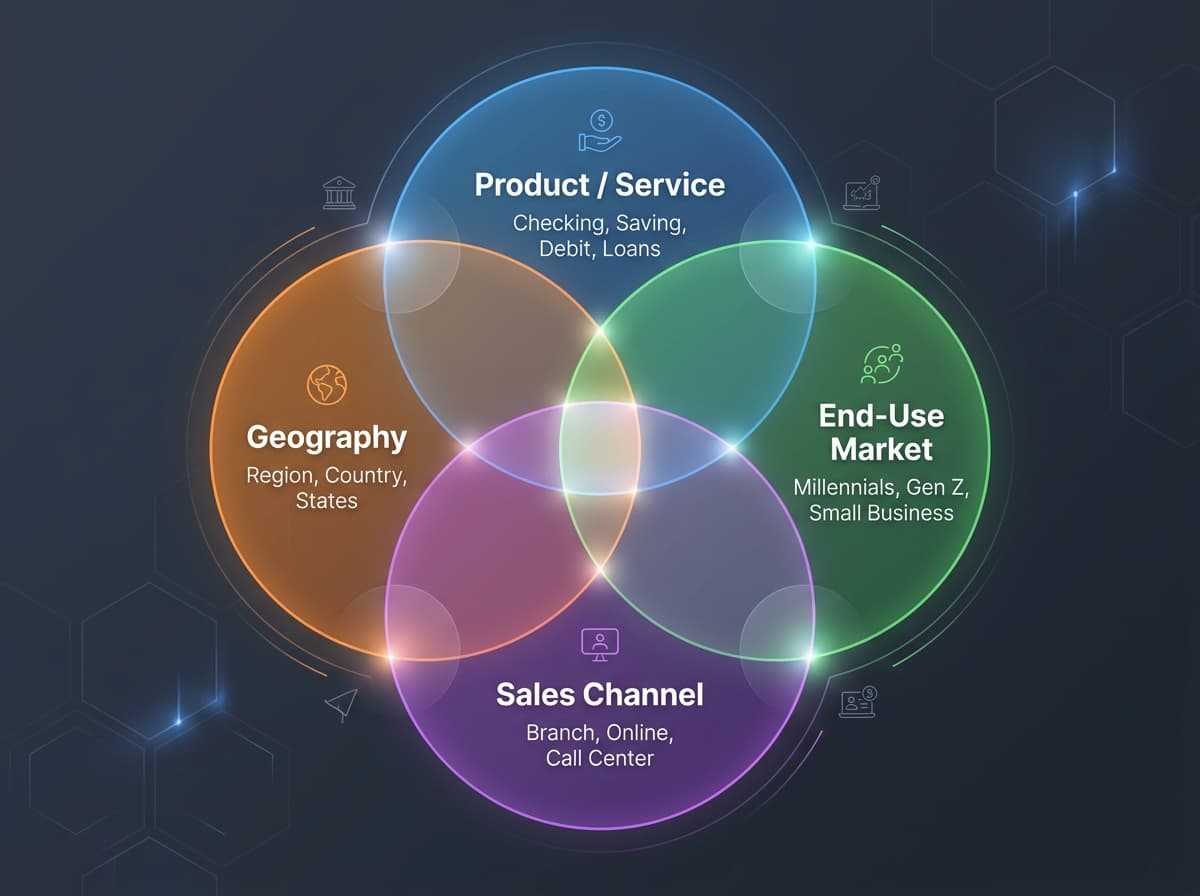
The banking industry is at a strategic crossroad because the old advantages of scale, brand trust, and regulatory expertise are no longer enough on their own. Fintechs have reduced the cost of serving customers, raised expectations for speed and usability, and forced banks to rethink where they can still create durable value.
The perfect storm is structural, not temporary
Banks are not facing a short-term cycle problem; they are confronting a structural shift in how financial services are designed, delivered, and consumed. McKinsey has estimated that financial-services firms have captured hundreds of billions of dollars in cost savings from digital and AI-related transformation, underscoring how aggressively the economics of the industry are changing.McKinsey
The pressure comes from three directions:
- Fintech competition: Digital-native firms can launch products faster, personalize more effectively, and often operate with lower overhead than incumbent banks.
- Consumer behavior: Customers increasingly expect real-time payments, mobile-first onboarding, and intuitive interfaces that resemble software platforms rather than legacy financial institutions.
- Margin compression: Rising compliance costs, lower interchange economics in some segments, and intense price competition reduce room for error.
HBR has long argued that digital disruption in banking is not just about technology adoption, but about rethinking the business model itself.Harvard Business Review That distinction matters: many banks have improved digital channels without fundamentally redesigning how value is created.
Why fintechs have an advantage
Fintechs usually win first on user experience, then on speed, and finally on specialization. They tend to attack narrow use cases where customers feel underserved, such as cross-border payments, small business lending, buy-now-pay-later, or embedded finance. Bain has noted that successful fintechs often expand by owning a specific customer problem end to end rather than trying to be full-service financial institutions from day one.Bain
A useful way to think about the gap is shown below:
| Strategic dimension | Traditional banks | Fintech challengers |
|---|---|---|
| Product speed | Slower due to legacy systems and governance | Faster product iteration and releases |
| Customer experience | Often fragmented across channels | Mobile-first, simpler, more intuitive |
| Cost structure | Heavy branch, compliance, and core-system costs | Leaner operating models |
| Trust and scale | Strong in regulated, high-trust products | Usually weaker brand trust, but improving |
| Data/analytics | Rich data but hard to operationalize | Better real-time product experimentation |
This is why banks can still win, but rarely by competing on fintech terms alone.
The strategic imperatives for traditional banks
The strategic question is not whether banks should change. It is how they should change, and where they can still defend a durable position.
1. Digital transformation is now table stakes
Digital transformation is no longer a differentiator; it is the minimum requirement for relevance. Gartner has consistently highlighted that customer experience and process digitization are central to enterprise competitiveness, especially in regulated industries where operational excellence affects both cost and retention.Gartner
For banks, this means:
- Modernizing core infrastructure where possible
- Reducing manual workflow dependencies
- Using AI for fraud detection, customer service, and credit decision support
- Simplifying onboarding and account servicing
- Designing experiences around customer journeys, not internal product silos
The most effective banks do not treat digital as a channel. They treat it as an operating model.
2. Partnership vs. build is a strategic choice, not a procurement decision
Many banks waste time debating whether to build everything internally or buy from vendors. The better question is where control matters most.
Banks should usually build capabilities that are core to differentiation, such as proprietary risk models, relationship banking workflows, or unique data advantages. They should often partner for commoditized capabilities such as identity verification, payment rails, and certain customer-facing fintech features.
This logic reflects a broader insight from MIT Sloan research: in digital ecosystems, firms often create more value by orchestrating capabilities than by owning every layer of the stack.MIT Sloan Management Review That is especially true in banking, where ecosystem partnerships can speed time to market while preserving strategic focus.
A bank that partners well can look like a platform without losing regulatory discipline.
3. Focus beats breadth in a fragmented market
The era of being “all things to all customers” is over. Banks that spread capital too thin across every segment often end up with average products, average experiences, and average economics.
Instead, leaders should concentrate on segments where they possess a meaningful edge. Examples include:
- Small business banking, where local relationships and cash-flow knowledge matter
- Wealth management, where trust and advice can outperform pure digital convenience
- Mortgage origination, where process efficiency and underwriting discipline create scale advantages
- Commercial banking niches, where sector expertise and relationship depth matter more than interface novelty
This is consistent with the strategy literature: specialization improves the odds of building a coherent value proposition and a defensible operating model.Harvard Business Review Banks that win usually win by being more relevant to a narrow customer set, not by trying to out-app every fintech on the market.
Corporate examples show what is working
The most instructive examples are not the banks that simply launched a mobile app. They are the banks that changed how they compete.
- JPMorgan Chase has invested heavily in technology and software talent, turning digital capability into a strategic asset rather than a support function. Its scale allows it to spread technology investment across a large customer base, but the key lesson is governance: it treats tech as a core business priority, not an IT side project.
- BBVA became one of the early global examples of a bank using digital transformation to simplify customer journeys and modernize internal processes. Its experience shows that design-led banking can improve both growth and efficiency.
- dbs bank in Singapore is frequently cited as a benchmark for digital reinvention because it combined cloud, data, and agile operating practices with a clear customer-centric agenda. It demonstrates that transformation works best when technology, culture, and leadership move together.
- Goldman Sachs’ Marcus showed both the promise and limits of consumer digital banking for incumbents: strong early momentum can still run into strategic questions about scale, economics, and fit with the parent institution.
The pattern is clear: banks do not win by copying fintechs feature for feature. They win by combining trust, data, regulation, and relationship depth with modern delivery.
What the next winning bank looks like
The future leader in banking will likely share five traits:
| Trait | What it looks like in practice |
|---|---|
| Selective scale | Invests deeply in chosen segments instead of pursuing every market |
| Modern architecture | Uses modular systems, APIs, and cloud where appropriate |
| Experience design | Makes products easy to understand, open, and self-serve |
| Ecosystem thinking | Partners to accelerate innovation and expand reach |
| Disciplined capital allocation | Funds only initiatives that improve customer value and economics |
This is why strategic planning matters so much. A bank cannot transform through isolated initiatives; it needs an integrated operating roadmap that connects market position, technology, talent, and economics. Our strategic planning process is designed to help leadership teams make those tradeoffs explicitly rather than reactively.
The leadership challenge is harder than the technology challenge
The biggest barrier to change is often not system architecture but organizational inertia. Legacy banks are usually structured around products, geographies, and control functions, which can slow decision-making and dilute accountability. Gartner has repeatedly emphasized that transformation succeeds when leaders align operating model, metrics, and governance—not just tools.Gartner
That means banking executives must answer hard questions:
- Which customer segment truly deserves priority capital?
- Which legacy businesses should be modernized, and which should be exited?
- Where will partnerships create speed without sacrificing control?
- How will success be measured: growth, retention, cost-to-income, or customer lifetime value?
Without those answers, digital transformation becomes a collection of expensive experiments.
The strategic crossroad ahead
Banks can still own the financial relationship if they move decisively. But the path forward requires choice, not caution. The winners will be the institutions that modernize their core, use partnerships intelligently, and concentrate on segments where trust, advice, and regulatory credibility remain powerful advantages.
The losers will be those that confuse activity with strategy: adding features without changing economics, launching apps without redesigning journeys, and investing in technology without changing the operating model.
For banks, the question is no longer whether fintech disruption is real. The question is whether leadership is willing to make the strategic tradeoffs that a new era demands.
[Join the waitlist for Strategy OS ->](Start your 7-Day Free Trial with Strategy OS →)
2026 Strategic Telemetry & Executive Implications
The banking industry's structural shift demands a granular re-evaluation of unit economics for 2026. Incumbent banks face a critical trade-off: the high cost of maintaining legacy infrastructure versus the imperative to invest in digital capabilities that lower customer acquisition costs (CAC) and improve customer lifetime value (CLTV). Fintechs have demonstrated superior CAC through agile digital marketing and seamless onboarding, often achieving a significantly lower cost-to-serve (CTS) per customer. For traditional banks, every new digital feature, from real-time payments to AI-driven personalization, must be rigorously tied to its impact on these core metrics.
Consider the implications of margin compression. While fintechs can often operate with leaner structures, banks grapple with escalating compliance costs and competitive pricing pressures. This necessitates a strategic pivot towards optimizing revenue per customer (RPC) through hyper-personalized offerings and efficient cross-selling, rather than solely relying on volume. The decision to build, buy, or partner for new technologies carries distinct unit-economic consequences. Building proprietary solutions offers long-term control but demands significant upfront capital and talent investment, potentially increasing short-term CTS. Acquiring or partnering can accelerate market entry but requires careful due diligence to ensure integration costs don't negate the benefits.
Executives must scrutinize the 'Strategy Drag' inherent in misaligned investments. For instance, a substantial investment in a new mobile app that fails to significantly reduce call center volumes or improve digital engagement represents a drag on profitability. Conversely, successful digital transformation can dramatically lower CTS, freeing up capital for further innovation or shareholder returns. The key is to model these trade-offs with precision, understanding that every strategic choice has a direct, quantifiable impact on the profitability of each customer relationship. Leveraging tools like the Strategy Drag Calculator becomes essential for quantifying the financial implications of strategic inertia versus proactive digital investment, ensuring that transformation efforts translate into tangible economic gains rather than just operational expenses.
Explore the Financial Services Capital Allocation in Full 3D
Decision Latency Cost, Yield Optimization & Automated Regulatory Shield. Test real-time scenario adjustments and observe strategic drag shifts live without setting up an account.
Quantify Your Organization's Strategic Drag
Static annual roadmaps and decision latency cost enterprise teams an estimated 15% in lost execution velocity. Run our 60-second diagnostic to calculate your dollar drag.
Start Playing with Strategy OS
Transform your static plans into dynamic knowledge with our AI-powered strategic platform.
Start Free Trial